

How to Style Boho Dresses for Work
Table of Contents
- Understanding Boho Style Basics for the Office
- How to Make a Boho Dress Look Professional
- How to Layer a Dress for Work
- Shoes to Wear with a Boho Dress
- Building Boho Work Outfits with Accessories
- Complete Work Outfit Formulas Using Boho Dresses
- Practical Considerations for Workday Wear
- Frequently Asked Questions
Last Updated: October 14, 2026
Understanding Boho Style Basics for the Office
Boho style blends vintage inspiration, natural textures, and flowing silhouettes.
The key to wearing boho dresses for work is knowing which elements stay and which need refinement.
Boho style emphasizes comfort without sacrificing presence. Pair the right silhouette with structured pieces, and you get outfits that feel authentically you while meeting workplace expectations.
How to Make a Boho Dress Look Professional
Making a boho dress work-appropriate starts with the dress itself. Silhouette, length, color, and pattern all matter.
Choose the Right Dress Silhouette and Length
The best boho dresses for work hit at or below the knee. Midi lengths are ideal for corporate environments, they provide coverage and formality while keeping that relaxed boho feel.
Look for these silhouettes:
- A-line or fit-and-flare cuts that define your waist
- Structured bodices with flowing skirts
- Wrap dresses that create natural waist definition
Avoid oversized, heavily ruffled, or extremely sheer styles for the office. The American Psychological Association research on workplace dress codes shows that professional appearance affects how colleagues perceive competence and authority.
Our Khaki Floral Print Ruffled Tiered Long Sleeve V Neck Midi Dress exemplifies this balance. The midi length, V-neckline, and tiered structure create visual interest without crossing into costume territory.

Opt for Neutral Colors and Minimal Patterns
Neutral tones read as more professional in office settings.
Pattern matters too: small-scale florals, subtle plaids, and delicate prints work better than large, bold patterns, which can overwhelm a professional space.
Solid-colored boho dresses are your safest bet for corporate environments. They pair easily with blazers and accessories without creating visual clutter.
How to Layer a Dress for Work
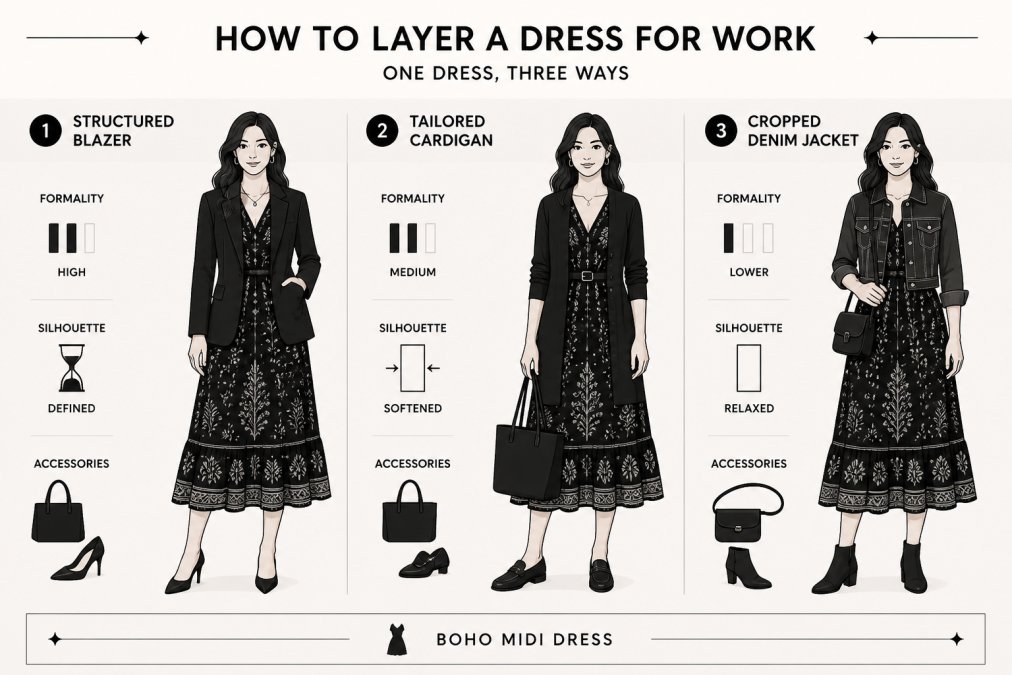
Layering is where most boho work outfits succeed or fall apart. The goal isn't warmth or coverage, it's introducing structure that counterbalances the relaxed drape of a boho dress. Two principles govern every good layer: proportion balance and formality matching.
Match the Layer to the Dress Volume
The most common mistake is layering a structured piece over an already-structured dress, or a loose layer over a loose dress. Both create bulk without shape.
- Full or tiered skirt, loose bodice: Add a fitted, cropped, or waist-length layer, a structured blazer, a fitted cardigan, or a cropped denim jacket. The contrast between a defined top layer and a flowing skirt creates an intentional silhouette.
- Fitted or wrap dress: You have more freedom. A longer blazer, a duster cardigan, or an open kimono works because the dress already defines your shape underneath.
- Straight or shift silhouette: Add a belt first, then layer. A belted dress under an open blazer reads as deliberate; an unbelted shift under an open blazer reads as shapeless.
Choose the Layer by Formality Level
Not every layer signals the same professionalism. Ranked from most to least formal:

- Structured blazer, the most formal option. Best for client meetings, presentations, and traditional corporate settings.
- Tailored cardigan, a close second. A fine-knit, button-front cardigan in a neutral color reads as polished in most business-casual offices.
- Knit blazer or sweater blazer, softer than a true blazer but more structured than a cardigan. A good middle ground for smart-casual workplaces.
- Denim jacket, business-casual only. Keep it dark-wash, fitted, and free of distressing.
- Kimono or duster, the most casual layer. Best reserved for creative offices, casual Fridays, or as a lightweight summer cover-up rather than a formality signal.
Layer Length and Hemline Mechanics
Where your layer ends changes how your outfit reads.
- Cropped layers (ending at the natural waist): Elongate the legs and emphasize the waist. Best over full-skirted or tiered boho dresses.
- Hip-length layers (ending at the high hip): The most universally flattering and the safest for the office. They cover the waistband area and create a clean vertical line.
- Mid-thigh layers: Add formality and coverage. Best over midi and maxi dresses.
Coverage and Dress-Code Considerations
Before you layer, check your workplace dress code for coverage requirements. Many business-casual policies specify that shoulders, upper arms, and the back be covered.
A lightweight cardigan or structured blazer solves most coverage issues without hiding the dress. For a deep V-neckline, add a camisole plus an open layer to keep it work-appropriate while preserving the boho feel.
Seasonal Layer Swaps
Your layering strategy should shift with the weather, not just the dress.
- Warm weather: Swap heavy knits for lightweight cotton or linen cardigans, or a breathable kimono. A structured blazer in a lightweight fabric (cotton blend, unlined) still works in air-conditioned offices.
- Cool weather: Layer a fine-knit cardigan under a blazer for warmth without bulk. Add tights and ankle boots to extend a summer boho dress into fall.
- Rainy days: Choose a water-resistant trench or a structured coat over your layer. Avoid long, dragging hems that soak up water, a midi or knee-length dress is more practical than a maxi in wet weather.
Shoes to Wear with a Boho Dress
Footwear makes or breaks a boho work outfit. The right shoes ground your look and signal professionalism.
Professional Footwear Options
Closed-toe shoes are essential for most office settings, providing formality and structure that open-toed sandals cannot match.
Best shoe choices for boho dresses:
- Loafers in leather or suede (neutral colors)
- Ballet flats or pointed-toe flats
- Ankle boots in leather
Avoid very trendy sneakers, flip-flops, or heavily embellished shoes. These undermine the professional polish you've built with your dress and layers.
Neutral shoe colors work best: black, brown, tan, cream, or navy.
Balancing Comfort and Professionalism
Look for shoes with:
- Cushioned insoles or padding
- Flexible soles that move with your foot
- Breathable materials for all-day wear
Boho style celebrates comfort, so choosing comfortable professional shoes aligns with your aesthetic.
Building Boho Work Outfits with Accessories
Accessories are where boho styling gets personal. They add character and polish without overwhelming your professional presence.
Selecting Minimal and Polished Accessories
Choose 2-3 accessories maximum:
- One statement piece (structured necklace or earrings)
- A professional bag
- A belt (optional, for waist definition)
Keep accessory metals matching, stick with gold, silver, or rose gold throughout.
Avoid excessive boho trinkets: multiple rings, layered necklaces, dangling charms, or ankle jewelry. These belong in weekend outfits, not office wear.
Using Belts and Bags to Define Your Look
A belt defines your waist and breaks up long dress lines.
Bags communicate professionalism. Choose structured handbags in leather or quality materials. Avoid slouchy, oversized, or heavily fringed bags for the office.
Khaki Floral Print Ruffled Tiered Long Sleeve V Neck Midi Dress →
Professional bag styles:
- Structured totes
- Crossbody bags
- Structured satchels
A neutral-colored bag (black, brown, tan, or navy) pairs with any boho dress.
Complete Work Outfit Formulas Using Boho Dresses
Having formulas removes daily decision-making stress. These combinations work across office environments.
Business-Casual Formula
Boho dress + cardigan + flats + minimal jewelry + structured bag
This combination works in creative industries, tech, and relaxed corporate settings. The cardigan adds structure without feeling formal. Flats keep things comfortable for a full workday.
Example: Our Khaki Plaid Pattern Collared Neck Ruffled Sleeve Shirt Dress paired with a cream cardigan, tan leather flats, small gold earrings, and a structured tan leather tote.

Corporate Formula
Boho dress + structured blazer + ankle boots + minimal jewelry + professional bag
This works in law firms, finance, healthcare, and traditional corporate environments. The blazer signals formality and authority. Ankle boots add polish and structure.
Example: A neutral boho midi dress layered with our Ivy Lane Button Up Collared Neck Blazer, paired with black ankle boots, small stud earrings, a structured black leather bag, and a neutral belt.
Creative Office Formula
Boho dress + denim jacket + loafers + statement earrings + leather bag
This works in creative industries, nonprofits, and design-forward companies. The denim jacket keeps things relaxed. Statement earrings add personality without feeling unprofessional.
Example: A patterned boho dress with our Boho Patchwork Cropped Denim Jacket, paired with leather loafers, gold statement earrings, and a structured leather crossbody bag.
Practical Considerations for Workday Wear
A boho outfit that looks great in a mirror can fail by 10 a.m. if it restricts movement, wrinkles badly, or doesn't survive a commute.
Dress-Code Tiers: What Works Where
Workplace dress codes vary widely, and the same boho dress can be appropriate in one setting and out of place in another.
Smart casual: More polished than business casual, less formal than corporate.
Corporate or business formal: The most restrictive tier.
Creative or casual: The most flexible tier. Denim jackets, kimonos, bold prints, and statement accessories are all fair game.
Fit and Proportion Troubleshooting
Shoulders: The shoulder seam should sit at or very near your natural shoulder.
Bust and armholes: No gaping at the neckline or armholes when you move.
Hips and skirt: The skirt should skim your hips and thighs without clinging.
Length: Knee-length or midi is safest for most offices.
Fabric and Comfort for a Full Workday
Boho dresses often use natural, breathable fabrics, a comfort advantage in the office. But not all fabrics perform equally over an eight-hour day.
- Cotton and cotton blends: Breathable, easy to care for, and hold shape reasonably well. Good for most office settings.
- Linen: Breathable and comfortable in warm weather, but wrinkles easily. Best for casual or creative offices, or for days when you are not sitting in long meetings.
- Rayon and viscose: Drape beautifully and feel soft, but can wrinkle and may not hold structure. Best paired with a structured layer.
For comfort, look for dresses with a bit of stretch, a lined skirt (to prevent clinging), and adjustable elements like wrap ties or elastic waists.
Movement, Sitting, and Commuting
Sitting: Sit in a chair and cross your legs.
Walking and stairs: Flowing skirts can catch on stairs, escalators, or chair wheels.
Temperature changes: Offices are often over-air-conditioned in summer and under-heated in winter.
Footwear comfort: Even the most professional shoe fails if it hurts by noon.
Frequently Asked Questions
Can you wear a boho dress to work in a corporate office?
Yes, boho dresses work in corporate settings when styled strategically. Choose midi or knee-length dresses in neutral tones or subtle prints, layer with a tailored blazer, and pair with professional footwear. The key is balancing the relaxed boho aesthetic with structured pieces that signal professionalism. Avoid overly flowing fabrics, bold patterns, or sleeveless styles without coverage.
How do you make a boho dress look professional for work?
Transform a boho dress for work by adding structured layers like a blazer or cardigan, choosing appropriate footwear such as loafers or professional flats, and keeping accessories minimal and polished. Select dresses with defined waistlines and appropriate length (midi or knee-length). Neutral color palettes and subtle patterns read as more professional than bold florals or earth tones combined with statement pieces.
What shoes should you wear with a boho dress to the office?
Pair boho dresses with professional footwear like loafers, ballet flats, pointed-toe flats, or low block heels. Avoid sandals, flip-flops, and heavily embellished styles. Neutral colors such as black, navy, tan, or white coordinate best with most boho dresses. For business-casual environments, clean sneakers or minimalist slip-ons work. Ensure shoes are polished and well-maintained to maintain a put-together appearance.
How do you layer a boho dress for a professional outfit?
Layer boho dresses with tailored blazers for corporate settings, cardigans for business-casual environments, or cropped denim jackets for creative offices. Add a structured belt to define the waist and create proportion. Long-sleeve dresses provide built-in coverage, while sleeveless styles need a jacket or cardigan. Keep layers neutral or complementary to the dress color to maintain a cohesive, intentional look rather than appearing pieced together.